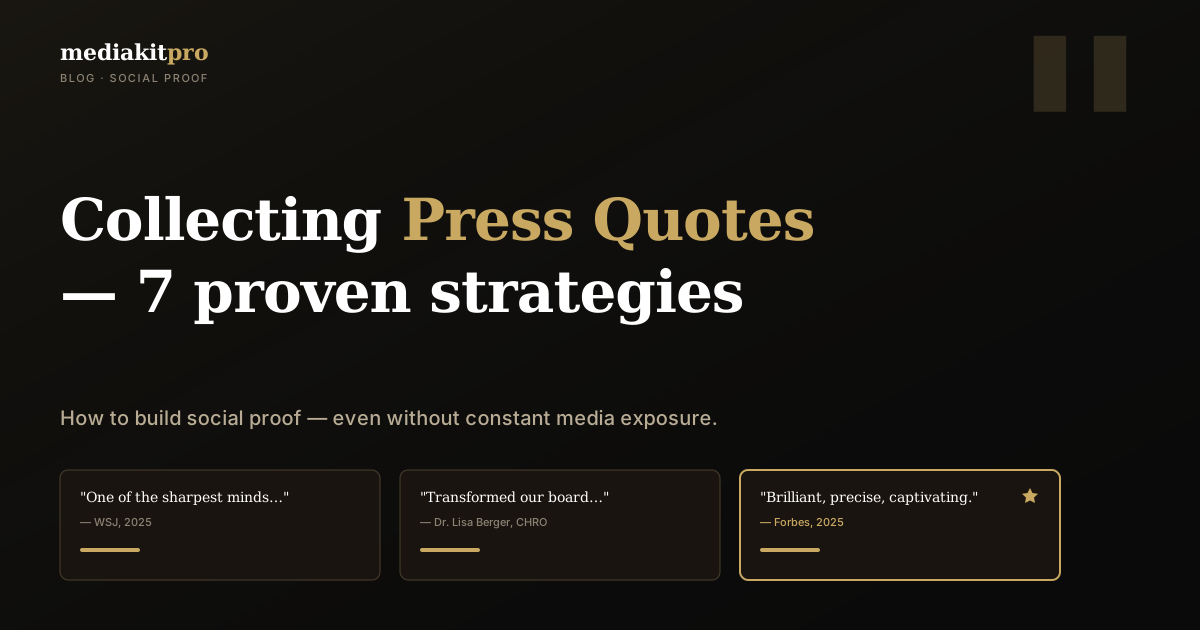
Collecting Press Quotes & Testimonials — 7 Proven Strategies
A media kit without testimonials doesn't sell. But how do you get good quotes if you're not constantly in the media? 7 proven approaches — from elegant client outreach to conference feedback mining.
Press quotes and testimonials are the strongest trust signal in your media kit. They convince buyers more than any self-description. And at the same time they're the hardest section to fill for many speakers, coaches, and consultants — because they don't know how to systematically get them.
This article shows you 7 proven approaches to regularly collect strong quotes. Plus templates for elegant client outreach and a few tricks for turning raw feedback into polished press quotes.
Why press quotes are so critical
Three reasons:
- Social Proof: Buyers trust peers more than self-statements. A quote from an industry insider weighs more than a perfectly written self-description.
- Concreteness: Press quotes often deliver what your bio can't — concrete outcomes, emotional impressions, comparisons.
- Differentiation: "Strategic consultant" is what everyone claims about themselves. "She transformed our board with one workshop" only the customer says.
Media kit analyses show: media kits with 4+ strong testimonials convert ~2× better than those with under 2 (or none).
Press quotes vs. testimonials — the difference
Separate clearly:
- Press quotes = quotes from media (WSJ, FT, Forbes, BBC, Guardian)
- Testimonials = quotes from clients, customers, organizers
Both have different effects:
- Press quotes signal institutional recognition ("Forbes finds her important")
- Testimonials signal practice success ("She solved our problem")
In your media kit you should have both — separated by section. If you only have one type, that's OK, but label it correctly.
The 7 ways to get press quotes
Way 1: Ask clients directly after workshop / coaching
The most common and underrated approach. Most clients gladly give feedback — but they don't do it on their own. You have to ask.
When to ask:
- Right after the workshop (1–2 days later, when impression is fresh)
- At early successes in coaching (e.g., after the first recognizable step)
- At end of program / engagement
How to ask — template:
"Hi [Name], I'm really pleased that [specific moment from your collaboration]. If you have a minute — would you write 2–3 sentences on what you particularly liked or what concrete benefit you got? I'd love to use it in my media kit, with your name and function. Let me know if anything bothers you or if you'd like specific phrasing avoided."
Response rate: typically 70–90 %. The simplest path of all.
Way 2: Systematically harvest conference / event feedback
Organizers often gather structured participant feedback after talks (NPS scores, free-text answers). Actively ask the organizer:
"Did the event team have a brief summary of participant ratings you could share? I'd love to use them for my media kit."
You typically get:
- Quantitative data (NPS score, point ratings)
- Free-text answers ("Best keynote of the day," "Finally someone speaking plain truths," etc.)
From the free-text answers you can distill testimonials — with attribution "Participant feedback, [Conference], [Year]."
Way 3: Actively request LinkedIn recommendations
LinkedIn has a Recommendations function you can systematically use. Process:
- Pick 5–10 contacts with relevant positions (L&D directors, organizers, past clients)
- Click "Request a Recommendation"
- Write a short, personal text (not the LinkedIn default)
Template:
"Hi [Name], we worked together in 2024 on [project/workshop]. If it's a fit for you, I'd appreciate a LinkedIn recommendation — ideally in 2–3 sentences on [concrete aspect of our collaboration]. You don't have to embellish — short and honest is perfect."
LinkedIn recommendations you can then use both on LinkedIn and in your media kit — usually with reference to LinkedIn profile as source.
Way 4: Recycle book blurb reactions
If you've written a book, you often have blurb endorsements and reviews. Both are gold:
- Blurb endorsements (from other bestselling authors or industry heavyweights): directly usable as press quote
- Reviews in industry media: quote with source "[Magazine], [Date]"
If you don't have a book yet but a much-cited industry article — applies similarly. Online article reactions from comments or Twitter/LinkedIn can often be distilled.
Way 5: Ask for quotes after media interviews
When you've been mentioned in press (interview, background article, podcast appearance), you can use the journalists'/hosts' statements as press quotes.
Examples:
- Interview in Forbes: headline "The AI Visionary" → excerpt usable as press quote
- Podcast appearance: host says "That was one of the most fascinating conversations this year" → quote
- Magazine profile: highlights from the article
Process:
- After publication scan the article/podcast entry
- Identify striking sentences (usually in lead or as highlight)
- Use with source: "[Magazine/Network], [Date], [Title]"
Way 6: Ask organizers for written statement
After a successful talk you can actively ask the organizer for a brief statement:
"Thanks for the wonderful event yesterday! If you have time — I'd really appreciate 2–3 sentences I could use as a testimonial. With your name and organizer position. I don't need anything elaborate — even a short note on what you particularly liked is helpful."
Organizers in 90 % of cases are grateful for the chance to do something nice for you. They give statements gladly — but again: they don't do it on their own.
Way 7: Distill from email confirmations and thank-you notes
If a client sends you a thank-you email after the coaching ("This really helped, thank you!"), that's implicitly a testimonial. Reply with:
"So nice to read, thank you! Quick question — may I use this sentence or an adapted version with your name in my media kit? Would help me reach new clients in similar situations as you."
You often get:
- Direct "Yes, gladly!" with original wording
- An expanded longer version
- Sometimes: "Yes gladly, but without real name" — also OK, you can work with function + industry without name
Turning raw feedback into polished press quotes
You rarely get a perfectly worded quote. You usually get raw feedback you have to polish (always with original's permission!).
Example: Raw feedback from a client
"Honestly, I was skeptical at first because I'd tried so many coaches and nothing really helped. But with you it was different, you were direct and concrete and helped me revise my pitch completely in just 6 weeks. Worked great."
Polished press quote
"I was skeptical — I'd tried many coaches. [Name] was different: direct, concrete. In 6 weeks we'd completely revised my pitch. It worked." — [Name], Function, Industry
What I did:
- Slowed down to clear sentences
- Cut repetitions
- Made concrete outcome ("Pitch in 6 weeks") prominent
- Replaced "you" with "[Name]" — works better in quote context
Important: Original person must approve the polished version. Rule of thumb: send the polished version back with "This is how I'd use it in the media kit — would that be OK?" Answer usually "Yes, perfect."
What makes a strong press quote
5 quality markers:
- Specific: Concrete situation, concrete outcome — not "was great"
- Credible: Real name with function and industry
- Short: 1–3 sentences. Long quotes get skipped
- Different: Says something other quotes don't say
- Buyer-relevant: Addresses a problem your audience has
If you have 4–6 quotes meeting all 5 criteria, you're in the top 10 % of all media kits in the US/UK market.
How many press quotes are enough?
| Career stage | Press quotes | Testimonials |
|---|---|---|
| Junior | 0–2 (OK without) | 3–5 |
| Mid-level | 2–4 | 4–6 |
| Senior | 3–6 | 4–8 |
| Star/Top-tier | 5–10 | 6–10 |
More isn't better. 12 mediocre quotes feel worse than 4 strong ones.
Common mistakes when collecting press quotes
Mistake 1: Anonymous quotes without context
"Top speaker!" — Source: anonymous. Sells nothing. If you can't use real names, then at least "L&D Director, Fortune 100 manufacturer."
Mistake 2: Self-written quotes as press quotes
Sometimes speakers try to pass off self-written "PR headlines" as press quotes. Buyers notice. Don't do it.
Mistake 3: Outdated quotes (>3 years)
"Impressive!" — Source: 2019. Your buyer thinks: "Has nobody had anything good to say since?"
Mistake 4: Quotes without date or source
Undermines credibility instantly. Date + source mandatory.
More media kit mistakes of this kind in the mistake article.
Workflow: collecting press quotes as a routine
So you don't panically search for quotes every 6 months, establish a quarterly routine:
Every 3 months (15 min):
- Search email inbox for client confirmations → identify 2–3 candidates, write to them
- Check LinkedIn mentions and activities → write to 1–2 candidates
- Recently held talks → write to organizers
With this routine you have 3–5 new press quotes per quarter, i.e. 12–20 per year. That's more than you'd ever show in your media kit — you can choose.
Using press quotes GDPR-compliant
Heads up: press quotes with real names are personal data. So:
- Written consent of the quoted person (email is fine)
- Specifically state where you use the quote (media kit, LinkedIn, website)
- Adaptations of original statement only with re-approval
- Right of withdrawal must be respected
For press quotes from media this doesn't apply — they're public and usable with attribution.
Conclusion
Collecting press quotes is systematic work, not luck. With the 7 ways above you have enough sources to add 4–8 strong quotes per year to your media kit. Biggest lever: actively ask instead of waiting. 90 % of clients give gladly — they just don't do it on their own.
Three immediate steps:
- Make a list of the last 10 clients / organizers
- Send personalized inquiry (template above) to 3–5 of them
- Set a quarterly reminder in your calendar — repeat this process every 3 months
If you want to know how your bio around the press quotes should look, bio guide with examples. How to use AI to polish press quotes, comes in the ChatGPT-for-media-kit article. What goes in your media kit: content checklist with all sections.
If you want to build your media kit with press quotes section directly: Free plan. Example with Press + Testimonial separated: Live demo.
On this page (23)
- Why press quotes are so critical
- Press quotes vs. testimonials — the difference
- The 7 ways to get press quotes
- Way 1: Ask clients directly after workshop / coaching
- Way 2: Systematically harvest conference / event feedback
- Way 3: Actively request LinkedIn recommendations
- Way 4: Recycle book blurb reactions
- Way 5: Ask for quotes after media interviews
- Way 6: Ask organizers for written statement
- Way 7: Distill from email confirmations and thank-you notes
- Turning raw feedback into polished press quotes
- Example: Raw feedback from a client
- Polished press quote
- What makes a strong press quote
- How many press quotes are enough?
- Common mistakes when collecting press quotes
- Mistake 1: Anonymous quotes without context
- Mistake 2: Self-written quotes as press quotes
- Mistake 3: Outdated quotes (>3 years)
- Mistake 4: Quotes without date or source
- Workflow: collecting press quotes as a routine
- Using press quotes GDPR-compliant
- Conclusion
Visibility tips, delivered to your inbox
One actionable tip every 2 weeks for speakers, coaches and consultants. Unsubscribe anytime.
You might also like
ChatGPT for Media Kits — 12 Prompts That Actually Work
AI is the best tool right now for media kit content. 12 ready-to-use ChatGPT prompts to copy — for bio, speaking topics, testimonial polishing, and more. Plus the most common pitfalls.
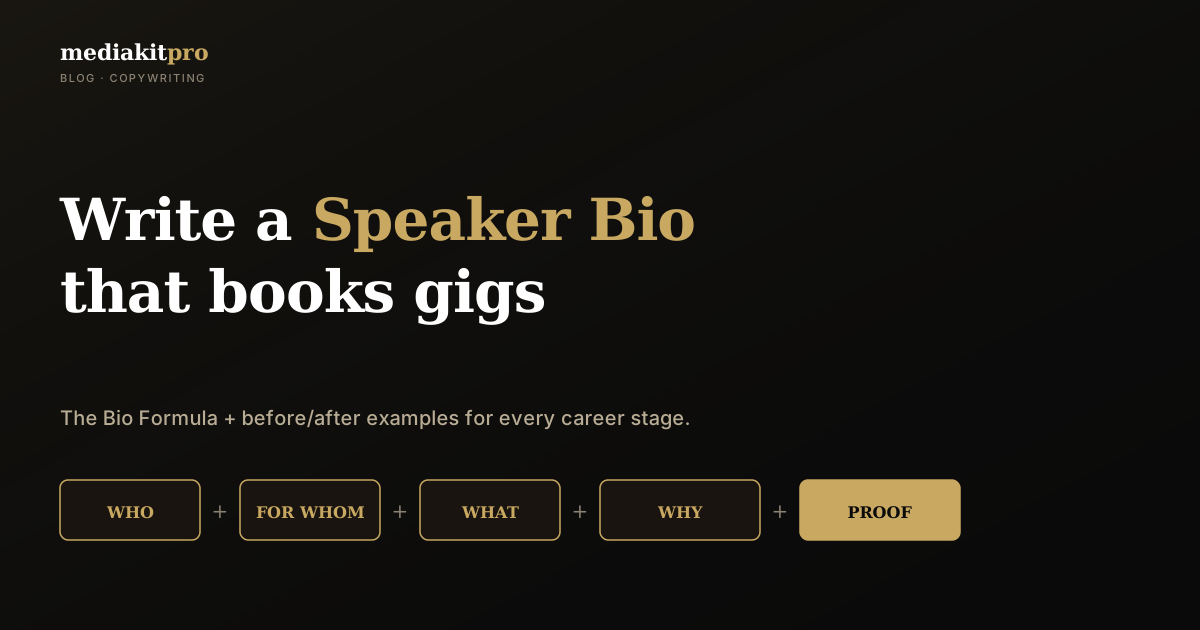
How to Write a Speaker Bio That Books Gigs (Templates Inside)
A strong speaker bio is the most important text in your media kit — and the one most people fumble. Here's the Bio Formula with before/after examples for every career stage.
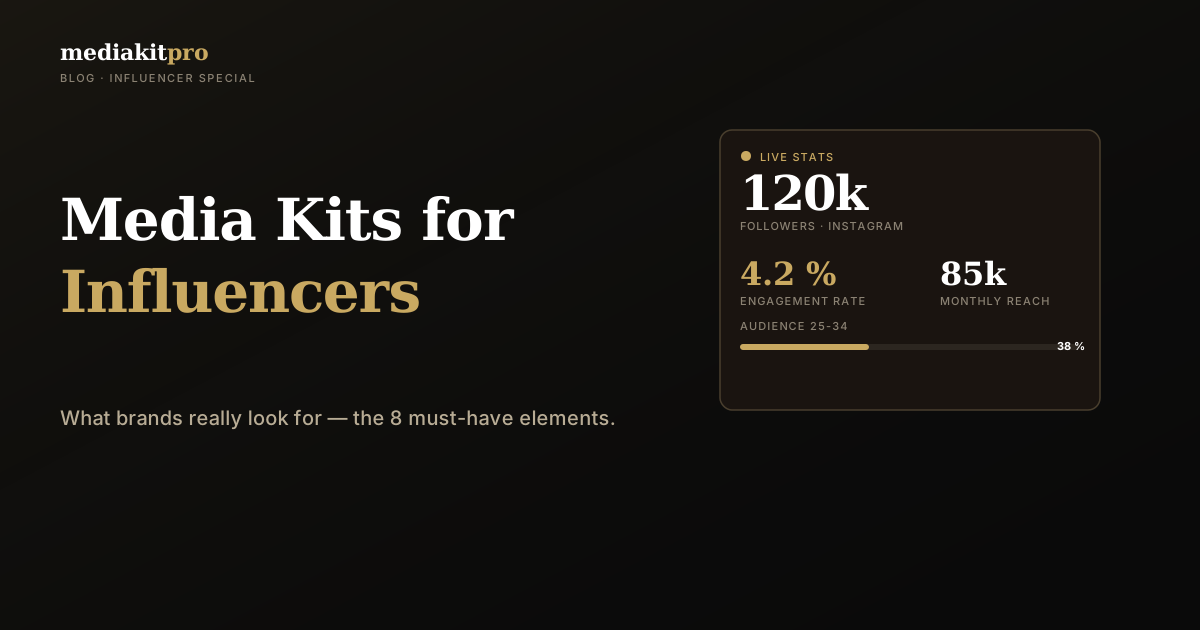
Influencer Media Kits: What Brands Really Look For (2026)
Influencer media kits are a different game: brands evaluate different data than event organizers. The 8 elements that really convince in brand pitches — with examples and best practices.