How to Write a Speaker Bio That Books Gigs (Templates Inside)
A strong speaker bio is the most important text in your media kit — and the one most people fumble. Here's the Bio Formula with before/after examples for every career stage.
Your speaker bio is the most important text in your media kit. It decides whether an organizer scrolls on or clicks to the competition. And it's also the text 80 % of all speakers fumble — too long, too generic, or too self-important.
This article shows you the Bio Formula, three length versions (short / medium / long), before/after examples for every career stage, and the most common pitfalls. By the end you'll have a bio that convinces in 30 seconds.
Why 80 % of speaker bios fail
The three most common problems:
- Too long: 250+ words, everything from birth date to hobbies. Organizers scan, they don't read.
- Too generic: "Inspirational Thought Leader with a passion for empowering teams." Says nothing.
- Too self-centered: "My journey, my vision, my mission." Organizers want to know what you do for THEM — not your life story.
The good news: all three problems can be solved with a single Bio Formula.
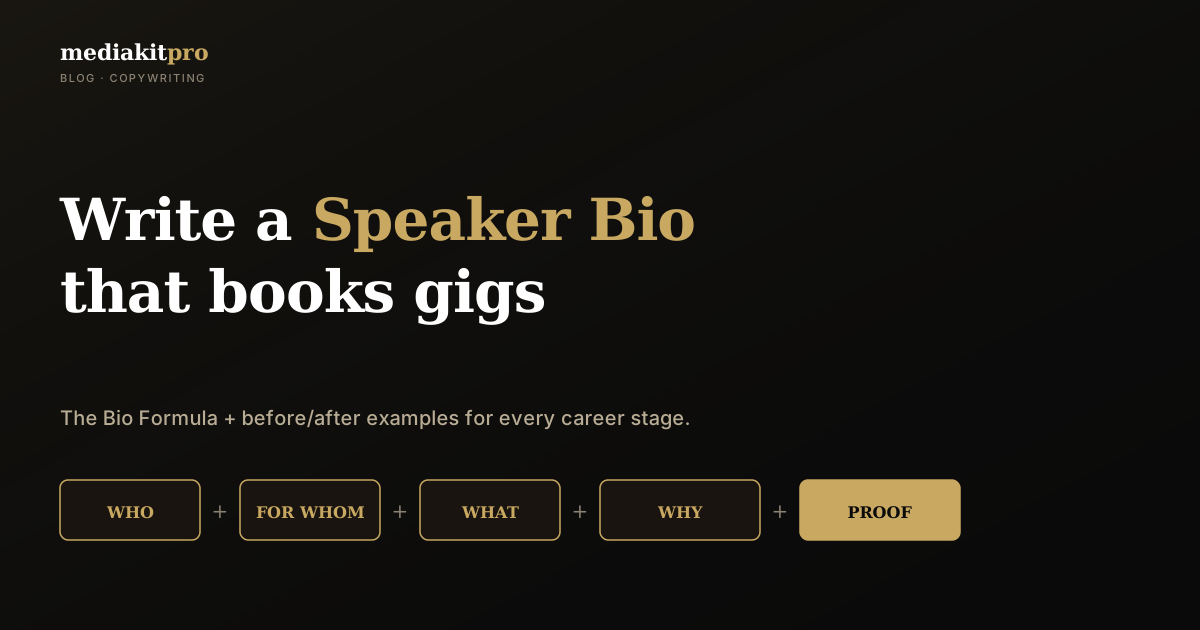
The Bio Formula: Who + Whom + What + Why + Proof
In this order:
- Who you are (Name + central role)
- For whom you work (concrete audience)
- What you concretely do (no buzzword, an action)
- Why that's relevant (which problem do you solve)
- Proof (1–2 strong references or awards)
That's the order an organizer would think — not the order you want to introduce yourself.
Three length versions — and when to use which
Short (50–80 words) — for event flyers, programs, LinkedIn headline
The most important text. Read most often. Must have everything important in one paragraph.
Medium (120–180 words) — media kit bio, conference website
Standard length for most use cases. Slightly more proof material, but still scannable.
Long (250–400 words) — "About me" section, press kit PDF
Optional. Only when explicitly asked or when your story is specifically sales-relevant (e.g., unusual vita that builds trust).
Rule of thumb: Write the short version first. Medium and long are extensions, not different texts.
Before/After: Three career stages
Example 1: Junior speaker (early career)
BEFORE (how most do it):
"I'm Sarah, a passionate trainer and coach focused on personal development. Since childhood I've been fascinated by the question of how people unlock their full potential. After studying psychology and several years in business, I decided to share my knowledge with others. My mission is to inspire and support people…"
Problems: First person, life story before competence, "passionate/mission/inspire" as buzzwords, no concrete proof.
AFTER:
"Sarah Mueller coaches solopreneurs in their founding phase with structured sparring sessions on positioning and first customers. In the workshop format 'First 10 Customers in 90 Days' she's coached over 80 founders in 2025 — with a 71 % conversion rate to paying first customers. Education: M.Sc. Psychology (NYU), Certified Business Coach (ICF)."
Changed: 3rd person, clear audience, concrete format, hard number, relevant certifications.
Example 2: Mid-level speaker (established)
BEFORE:
"With over 200 talks worldwide, Dr. Klaus Mueller is one of the leading experts on AI and digitalization. His new book 'Designing Digital Transformation' published by Wiley. Klaus is passionate about helping companies on their journey into the digital future…"
Problems: "One of the leading" is everywhere, nothing specific, "passionate" as buzzword.
AFTER:
"Dr. Klaus Mueller advises Fortune 500 boards on integrating AI systems into operational decision-making processes. In his keynotes he transfers concrete frameworks from accompanying 14 corporate projects (2022–2025) — including Microsoft, GE, and Verizon. His book 'Designing Digital Transformation' (Wiley 2024) is required reading at MIT Sloan Executive Education."
Changed: Specific audience (Fortune 500 boards), concrete activity (AI integration), named references with number, book with institutional proof.
Example 3: Senior speaker (top tier)
BEFORE:
"Prof. Dr. Sabine Weber is a bestselling author, multi-award-winning speaker, and internationally sought-after consultant. Her work has shaped the thinking on modern leadership in the US. Sabine is regularly featured in the media and has been advising top executives across the US and internationally for over 20 years."
Problems: 3 adjectives without proof, "shapes the thinking" is self-elevation, "regularly in the media" too vague.
AFTER:
"Prof. Dr. Sabine Weber holds an MBA in Management Information Systems and has been advising boards at mid-market and Fortune 500 companies since 2008. Her bestseller 'The AI Strategist' (HarperBusiness 2024) reached #3 on the NYT business bestseller list. She holds professorships at Harvard Business School and INSEAD and comments on AI topics regularly in WSJ, Forbes, and CNN."
Changed: Concrete activity description + industry focus, concrete bestseller rank, specific professorships, specific media.
The Who + Whom + What + Why + Proof in detail
Element 1: Who you are (5–15 words)
Name + central role. No adjectives. If title (Dr./Prof.) — use it, because relevant in B2B context.
Strong: "Dr. Klaus Mueller advises…" Weak: "Klaus is a passionate consultant…"
Element 2: For whom you work (10–20 words)
Concrete audience. Not "companies" or "executives" — but "Fortune 500 boards" or "solopreneurs in founding phase" or "Heads of People in tech scale-ups".
Specific sells. Generic disappears.
Element 3: What you concretely do (10–30 words)
No buzzword. What do you literally do?
Strong: "accompanies the integration of AI systems into operational decision processes" Weak: "inspires executives to transformative action"
Element 4: Why that's relevant (Optional, 10–20 words)
Which problem do you solve? For very clearly understood activities you can skip this. For abstract topics it's required.
Element 5: Proof (15–40 words)
One of the following:
- Concrete reference with real names
- Concrete number (number of projects, conversion rate)
- Bestseller status / award
- Professorship / institutional position
- Media presence with specific outlet/network
Never: Multiple proof points listed. One is enough — the strongest.
The most common bio pitfalls
Pitfall 1: "With over 20 years of experience…"
Says nothing. Anyone with 20 years can claim this. What did you do in those 20 years concretely?
Pitfall 2: Adjectives above all
"Passionate, dynamic, results-oriented" — these are words everyone claims about themselves. They obscure rather than inform. Instead: concrete verbs + concrete audiences.
Pitfall 3: Resume format
"Studied X, worked at Y, founded Z, wrote A." That's a CV, not a sales bio. Organizers want to know what you do today for them.
Pitfall 4: Self-positioning
"Was born in / lived in / found her way through…" — interesting for your mother, not for organizers.
Pitfall 5: Buzzword festival
"Visionary Thought Leader with a passion for empowering teams to achieve transformational outcomes." Translation: nothing.
More media kit mistakes of this kind in the mistake article.
Bio templates to copy-paste
Coach template
"[Name] coaches [concrete audience] with [concrete format] on [concrete theme]. In over [number] [engagements/programs/years] [he/she] has achieved [concrete outcome number]. Education: [most relevant certification/degree]."
Speaker template
"[Name] gives keynotes on [concrete theme] for [concrete audience]. [His/Her] [book/study/position] '[Title]' ([Publisher/Year]) [concrete success]. [Professorship/institutional position] and commentator on [topics] in [Outlet 1, Outlet 2]."
Consultant template
"[Name] advises [concrete audience] on [concrete task]. [His/Her] [methodology/program/format] is based on [number] [projects/engagements] with brands like [Brand 1, Brand 2, Brand 3]. [Academic/institutional position]."
What about the "About me" story?
Some think: "But my personal story is what makes me unique?"
That's true — but it doesn't belong in the bio. It belongs:
- In a separate "About me" section further down on the media kit
- In your book or newsletter
- In your LinkedIn About (if you want to show personality there)
The bio in the media kit has a different job: fast sales information for buyers. Personal story kills this job.
How to write your bio in 15 minutes
Three steps:
Step 1: Brainstorm (5 min)
Write the 5 bio elements raw:
- Who are you?
- For whom do you work?
- What do you concretely do?
- Which problem do you solve?
- What's your strongest proof?
Step 2: Condense (5 min)
Write a first draft from the 5 elements. Don't style, just sequence the content.
Step 3: Polish (5 min)
- Remove all adjectives without substance
- Remove all buzzwords
- Remove resume elements
- Read aloud — does it flow? If not, cut
Bio test: 5 questions for your finished bio
Before you publish:
- Is what you do clear in the first 15 words?
- Is your concrete audience there?
- Do you have at least one concrete proof point?
- Is the bio free of buzzwords?
- Could a buyer imagine, after reading, what they'd get with you?
If you answer all 5 with "Yes," you have a strong bio.
Conclusion
A strong speaker bio isn't lyrical or inspirational — it's concrete and scannable. With the Bio Formula (Who + Whom + What + Why + Proof) you have a version in 15 minutes that convinces organizers.
If you want to know how to get good press quotes for your bio, our press quotes article. If you have specific requirements as a coach: Coach media kit elements. If you want to use ChatGPT for bio writing, ready-to-use AI prompts here.
If you want to rebuild your media kit and get the Bio Formula guided directly in the editor: Free plan, no credit card. Example bio in live media kit: Demo.
On this page (33)
- Why 80 % of speaker bios fail
- The Bio Formula: Who + Whom + What + Why + Proof
- Three length versions — and when to use which
- Short (50–80 words) — for event flyers, programs, LinkedIn headline
- Medium (120–180 words) — media kit bio, conference website
- Long (250–400 words) — "About me" section, press kit PDF
- Before/After: Three career stages
- Example 1: Junior speaker (early career)
- Example 2: Mid-level speaker (established)
- Example 3: Senior speaker (top tier)
- The Who + Whom + What + Why + Proof in detail
- Element 1: Who you are (5–15 words)
- Element 2: For whom you work (10–20 words)
- Element 3: What you concretely do (10–30 words)
- Element 4: Why that's relevant (Optional, 10–20 words)
- Element 5: Proof (15–40 words)
- The most common bio pitfalls
- Pitfall 1: "With over 20 years of experience…"
- Pitfall 2: Adjectives above all
- Pitfall 3: Resume format
- Pitfall 4: Self-positioning
- Pitfall 5: Buzzword festival
- Bio templates to copy-paste
- Coach template
- Speaker template
- Consultant template
- What about the "About me" story?
- How to write your bio in 15 minutes
- Step 1: Brainstorm (5 min)
- Step 2: Condense (5 min)
- Step 3: Polish (5 min)
- Bio test: 5 questions for your finished bio
- Conclusion
Visibility tips, delivered to your inbox
One actionable tip every 2 weeks for speakers, coaches and consultants. Unsubscribe anytime.
You might also like
ChatGPT for Media Kits — 12 Prompts That Actually Work
AI is the best tool right now for media kit content. 12 ready-to-use ChatGPT prompts to copy — for bio, speaking topics, testimonial polishing, and more. Plus the most common pitfalls.
Collecting Press Quotes & Testimonials — 7 Proven Strategies
A media kit without testimonials doesn't sell. But how do you get good quotes if you're not constantly in the media? 7 proven approaches — from elegant client outreach to conference feedback mining.
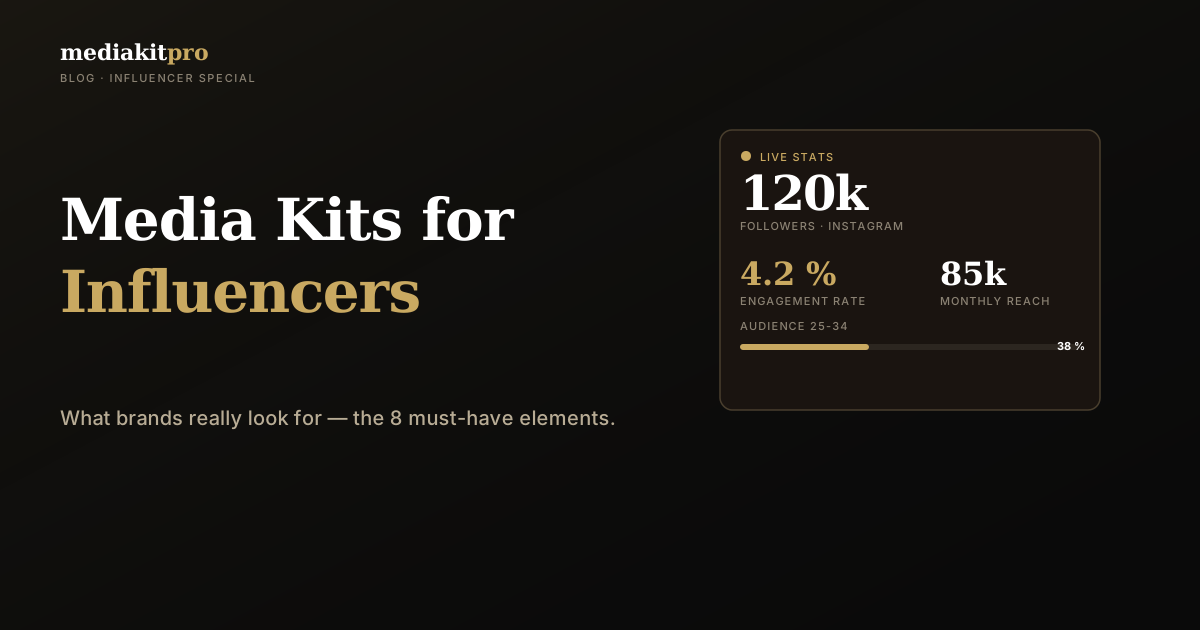
Influencer Media Kits: What Brands Really Look For (2026)
Influencer media kits are a different game: brands evaluate different data than event organizers. The 8 elements that really convince in brand pitches — with examples and best practices.